


Hu-rizon Roadshow in Pécs: international research against epidemics and diseases lead by Hungarian researchers


On 9 April, the latest stop of the HU-rizon Roadshow took place in Pécs, hosted by the University of Pécs. During the event, the large audience had the opportunity to learn about HU-rizon projects and research findings led by the host University of Pécs and other outstanding Hungarian universities.
The event confirmed that, in addition to addressing pressing and highly topical challenges, HU-rizon projects also make a significant contribution to enabling Hungarian research teams to fully leverage the opportunities offered by international cooperation.
Participants of the roadshow were welcomed via video message by László Bódis, Deputy State Secretary for Innovation at the Ministry of Culture and Innovation, who highlighted in his address: “It is a great source of pride for us that, within the framework of the HU-rizon Programme, Hungarian universities have demonstrated their ability to attract the interest of the world’s leading universities in the field of research collaborations.”
Without adequate resources, even the best ideas are likely to remain on the drawing board, and even the most forward-looking collaborations cannot come to fruition. In his welcome address, Dr Attila Miseta, Rector of the University of Pécs, also emphasised that domestic resources and national funding are indispensable for scientific progress.
Dr László Lengyel, Vice President for Science and International Affairs at the National Research, Development and Innovation Office (NRDI Office), pointed out that the HU-rizon Programme enables many young researchers to become integrated into the international scientific community. As he put it: “We believe that it is through well-trained young researchers that we can make progress in the world.”
Dr Borbála Schenk, Head of the Department for International Cooperation at the NRDI Office, presented the results achieved so far under the HU-rizon Programme and shared several key figures with the audience: in the 2024 and 2025 calls, 15 Hungarian universities were awarded nearly HUF 20 billion in funding to implement a total of 53 projects, while 134 international partners from 30 countries across five continents joined the collaborative research efforts. The Head of Department also stressed that, beyond supporting research aimed at improving people’s well-being, the HU-rizon Programme seeks to foster a strong and cohesive Hungarian research community among participating researchers. The events of the HU-rizon Roadshow also serve this objective.
Following the opening remarks and introductory presentations, researchers from Pécs were the first to present their projects to the audience. Dr Tamás Ágh and his research group, operating under the name COPD-ALERT, aim to predict acute exacerbations of chronic obstructive pulmonary disease (COPD) through the artificial intelligence-based monitoring of medical data. The research involves collaboration with experts from the Department of Clinical Pharmacy and Pharmacology at the University Medical Center Groningen, as well as the Department of Family Medicine at the Medical University of Lodz.
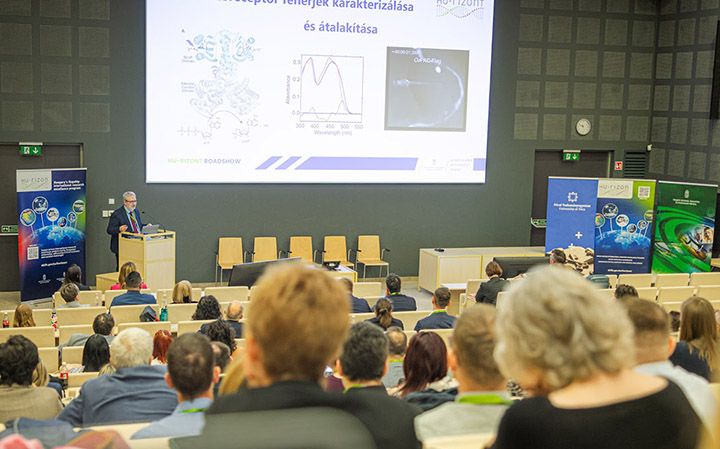
In the OPTOGENETICS project, Prof András Lukács and his team are developing fusion proteins by linking a light-sensitive molecule, a photoreceptor, to another protein with a specific function in the cell, thereby introducing light-switchable properties into cellular processes. These research efforts may ultimately enable active substances to exert their effects precisely where and when they are needed in the body. The research group’s international partners include École Polytechnique (France), the University of East Anglia, and the European Synchrotron Radiation Facility (ESRF) in Grenoble.
 |
| Prof. András Lukács, Photo: Szabolcs Csortos, PTE |
Dr Gábor Kemenesi presented two projects implemented under his leadership. Under the SENTINEL programme, awarded funding in 2024, the team is developing rapid, decentralised, highly sensitive, PCR-equivalent point-of-care tests (POCT), enabling the swift and efficient detection of certain viruses (such as the viruses causing Crimean-Congo haemorrhagic fever and the Nipah virus), thereby helping to prevent their spread. The project is carried out in collaboration with the University of Oxford, the Pasteur Institute Novi Sad, Chattogram Veterinary and Animal Sciences University in Bangladesh, as well as the Balkan Association for Vector-Borne Diseases. The other project, VANGUARD, funded under the 2025 HU-rizon call, aims to make research conducted in the highest biosafety level (BSL-4) laboratories safely transferable to facilities with lower biosafety classifications. This is essential, as it would significantly expand available research capacities for the development of effective vaccines and therapeutics against deadly viruses. The work is conducted in cooperation with renowned and reputable partners such as the University of Oxford, Université Libre de Bruxelles, and Zatloukal Innovations, which brings decades of experience in biosafety.
Following the presentation of local projects, four additional HU-rizon projects launched in 2024 presented the first-year results of their research during the event’s “open mic” session. In the FRATERNITY project, the University of Debrecen, in cooperation with the University of Florida and Seoul National University, is working on the development of a cooperative environment suitable for testing autonomous vehicles. The AMR BIRDS programme, also led by the University of Debrecen, investigates the role of migratory birds in the spread of antimicrobial resistance, in close collaboration with the universities of Oxford, Zurich and Freiburg, as well as the Hortobágy National Park. The PFAQuatic project, implemented under the auspices of the Hungarian University of Agriculture and Life Sciences (MATE), studies the environmental impact of certain perfluoroalkoxy (PFA) compounds in surface waters, aquaculture systems, and related agricultural products. Its collaborating partners include the University of Birmingham, the Helmholtz Centre for Environmental Research in Germany, and the University of Pécs. Last but not least, the AI-NEXT project of Corvinus University of Budapest (BCE) was also presented. The project aims to establish the scientific foundations of a Precise, Transparent and Verifiable AI (PTV AI) system, including, among others, its application in the healthcare sector. In this work, Corvinus University of Budapest collaborates with the University of Washington and The Chinese University of Hong Kong.
Following the presentations, a roundtable discussion moderated by Flóra Csesznok, staff member of the Department for International Cooperation at the NRDI Office, brought together researchers involved in HU-rizon projects in Pécs to share their insights on the benefits and challenges of international cooperation in the healthcare sector. Topics included how a Hungarian research idea evolves into an international collaboration within the framework of the HU-rizon Programme, the opportunities offered by engaging international partners, and the challenges associated with leading such collaborations. The discussion featured contributions from Dr Ildikó Pécsi, Dr Sándor Kovács, Dr Roland Hetényi and Dr Dániel Hanna.
The professional programme concluded with a closed-door skills development workshop organised for HU-rizon project research teams, addressing a key practical question: how to build broad international visibility for outstanding Hungarian research through strategic approaches. Led by Dr Borbála Schenk, participants engaged in interactive exercises to explore the tools and methods for enhancing the international visibility of research projects; how to build a strong personal brand for research teams; and how to effectively participate on online platforms (LinkedIn, publication interfaces, university channels), as well as in-person events (searching for consortium partners, pitching techniques).
The highly successful event series is set to continue in the autumn, offering further opportunities for professional dialogue with participants.