


Detailed information on the renewal of the system, and in particular the future of the cooperative doctoral model, is provided in the handbook compiled on the subject, while the list of former Cooperative Doctoral Programme (with Hungarian abbreviation: KDP) employers is also available. We interviewed Dr. Péter Domokos, President of the Research Council of Hungary, about the strategic objectives and the background of the transformation.
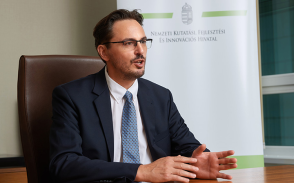
Dr. Péter Domokos, President of the Research Council of Hungary
Last year’s reform of doctoral education in Hungary introduced a number of forward-looking innovations – one of the most significant being undoubtedly the institutionalisation of the cooperative training model. The Cooperative Doctoral Programme (KDP, later EKÖP-KDP), which has been a key element of Hungary’s research talent support system since 2020 as a scholarship scheme managed by the NRDI Office, has proven to be a fertile ground for university-industry cooperation in recent years. In light of the model’s success, this initiative was integrated into the range of doctoral training opportunities in 2025 as an independent form of doctoral education. Detailed information on the renewal of the system, and in particular the future of the cooperative doctoral model, is provided in the handbook compiled on the subject, while the list of former Cooperative Doctoral Programme (with Hungarian abbreviation: KDP) employers is also available. We interviewed Dr. Péter Domokos, President of the Research Council of Hungary, about the strategic objectives and the background of the transformation.
Why was it necessary to renew the doctoral training system in Hungary?
Péter Domokos: Doctoral training is one of the most important foundations of research and innovation talent development; therefore, it is a strategic issue how competitive the opportunities it offers are, and how it can engage, motivate, and retain talented young people in the country. This is particularly important in the case of Hungary, as one of the areas of our scientific and innovation performance most in need of development is the relatively low number of research and development personnel. In the international research and university world, the work carried out by doctoral students is of immense significance. The maintenance and further development of a high scientific and technological standard largely depend on this. In contrast, the doctoral training system established in Hungary thirty years ago has by now drifted significantly apart from the models currently applied in advanced scientific societies. For this reason, the reform launched in 2025 aims to bring us closer to successful international university and scientific practices, namely in a way that doctoral training – alongside supporting scientific excellence – also serves innovation and labour market demands. The true measure of success will be if, thanks to the renewal, the number of entrants into doctoral training and the quality of doctoral students’ research programmes increase substantially, which will ultimately also be reflected in a growing number of degree awards.
What does the new, three-pillar doctoral training model mean in practice?
Péter Domokos: The essence of the new system is that research excellence doctoral training and cooperative doctoral training have emerged as two new pillars of doctoral education. These are independent training pathways in which doctoral students carry out scientific research under an employment contract. The third pillar remains the traditional doctoral training model, which continues to provide the previously established route to obtaining a doctoral degree, either through state-funded scholarships or self-financed participation.
What is the rationale behind this reform? A PhD degree certifies proficiency in scientific research, so it is only natural that it can primarily be mastered by conducting scientific research. Scientific research, however, is a serious professional work, typically carried out under an employment contract. Research excellence doctoral training offers young researchers the opportunity to launch their research careers in an inspiring professional environment by working on multi-year, funded research projects. The interest is mutual, as these projects also rely on ambitious young researchers. One of the most important instruments for this training pathway is the National Research Excellence Programme, which provides new research positions for up to 300–350 doctoral students each year, as well as the opportunity to join research topics whose significance and novelty are verified by evaluation from panels consisting of Hungarian and international experts. This concept corresponds to the “PhD researcher fellowship” model commonly applied in the Western world.
Cooperative doctoral training is tailored for those who perform their work in places where research is an integral part of the operations. This may include, for example, working on a business solution at an industrial company or a healthcare provider, or even as an assistant lecturer at a university, taking part in teaching and other duties alongside departmental research work. The distinctive feature of cooperative doctoral training is therefore that the research work conducted in pursuit of the doctoral degree is directly utilised in the institutional environment or in the economy. Generally speaking, the new system contributes to elevating both the evaluation and self-evaluation of doctoral students to a higher level: rather than focusing on the student role, greater emphasis is placed on the research profession and independent professional responsibility.
What role does cooperative doctoral training play in this system?
Péter Domokos: Cooperative doctoral training is a particularly important element of the reform because, continuing its original mission, it further strengthens the relationship between universities and economic actors. It supports doctoral students who plan to pursue their careers in medical, healthcare or other corporate innovation environments. This not only means a more competitive, more predictable career path for young people but is also an effective tool for employers to involve highly qualified research talent into their operations. At the same time, it provides a framework for addressing the issue that doctoral students conducting research under the guidance of university supervisors perform significant work within universities.
What advantages does the reform offer doctoral candidates?
Péter Domokos: One of the most important advantages is the expansion of opportunities and perspectives, enabling conscious career planning. Thanks to this reform, doctoral students can now choose the form of training that best aligns with their own career goals and is most motivating for them. It is also a significant aspect that the amount of remuneration has increased substantially, financing has become more modern, and several regulations have been introduced to incentivize timely and successful degree attainment. The regulation of certain matters, such as the use of the credit system or the prescription of mandatory contact hours, has fallen under the competence of the universities. On the one hand, this strengthens institutional autonomy; on the other hand, it allows doctoral schools to tailor requirements to their own research profiles, enabling them to develop an even more research-focused curriculum.
How can the new doctoral system contribute to Hungary’s competitiveness?
Péter Domokos: In a knowledge-based economy, researchers, developers, and innovators are among to most important drivers of growth. If the system of doctoral training is of high quality, and if it is capable of engaging the most excellent, committed, and talented young people, it directly increases the country’s innovation performance, improves the technological capabilities of companies, and strengthens the international position of domestic higher education.