


Up in smoke? - Quite the opposite: a world-class Hungarian innovation turns CO2 into profit


While anyone can let money “go up in smoke”, making money out of smoke is a far greater challenge. The innovation of a Hungarian SME, eChemicles Zrt., does exactly this: it produces valuable raw materials from carbon dioxide. CO2 is entering the atmosphere in increasing quantities worldwide, acting as the primary driver of the greenhouse effect, and thus, global warming and the climate crisis. We talked about the invention – which received the 2025 DeepTech Award from the National Research Development and Innovation Office (NRDI Office) – with the company’s co-founder, Csaba Janáky.
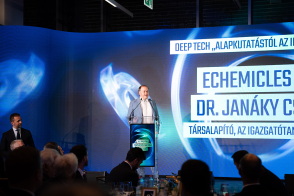
Csaba Janáky, eChemicles Zrt.
2025 DeepTech Award
Photo: Hungarian Innovation Association
Removing carbon dioxide from the atmosphere is a noble goal – but with your technology, it even generates economic value. What kind of value can be created from it, and how?
Our goal is not just to capture carbon dioxide, but to utilise it rather than store it. We aim to produce a useful product that has a market demand but is currently manufactured using other means, typically from natural gas or crude oil. In our case, this product is carbon monoxide.
For most people, carbon monoxide is known primarily as a highly dangerous substance – something that requires a detector at home near the boiler to prevent poisoning. However, the global chemical industry produces 150 million tonnes of carbon monoxide each year, and converts it into a wide range of chemical products, plastics and fuels. Today, this widely used intermediate raw material is still typically produced from natural gas. With our technology, however, carbon monoxide can be manufactured from “waste” – that is, from the carbon monoxide that has been puffed into the air until now.
How is carbon dioxide converted into a useful product?
There are numerous technical solutions available for this. The gas can be converted into various useful products using chemical, biological, or catalytic methods – or through electrochemical methods, which is our approach. It is important to understand, however, that carbon dioxide is a very stable molecule; therefore, energy must be invested to transform it. In our technology, this energy is provided in the form of electricity: during a process called electrolysis, we first convert carbon dioxide into carbon monoxide, and then further process that carbon monoxide into ethylene. This is particularly important because it allows us to use green energy for the process, as most green energy – whether from renewables or nuclear power – is available in the form of electricity.
How does it work in practice?
Imagine an emission point, such as a factory, where carbon dioxide is released through chimneys. A carbon capture technology needs to be installed at such a site. Countless companies manufacture such equipment – that is not the novelty here; the innovation lies in feeding the captured carbon dioxide into our system. Currently, we have container-sized units being tested by our partners in various industrial environments. In addition, a power source is required: the electricity can be supplied from the grid, but we already have experience connecting our equipment directly to a solar power plant. A certain amount of water is also necessary for the process. When all these components are in place, a gas mixture rich in carbon monoxide is generated on the product side.
The greatest advantage of our technology is that there is no need to replace the existing, extremely expensive chemical industry infrastructure. The carbon monoxide produced by our method is the exact same molecule as that produced from natural gas; consequently, all subsequent processing steps – every downstream conversion – remain exactly the same. Therefore, the same existing technology can be utilized, only the source of the raw material changes.
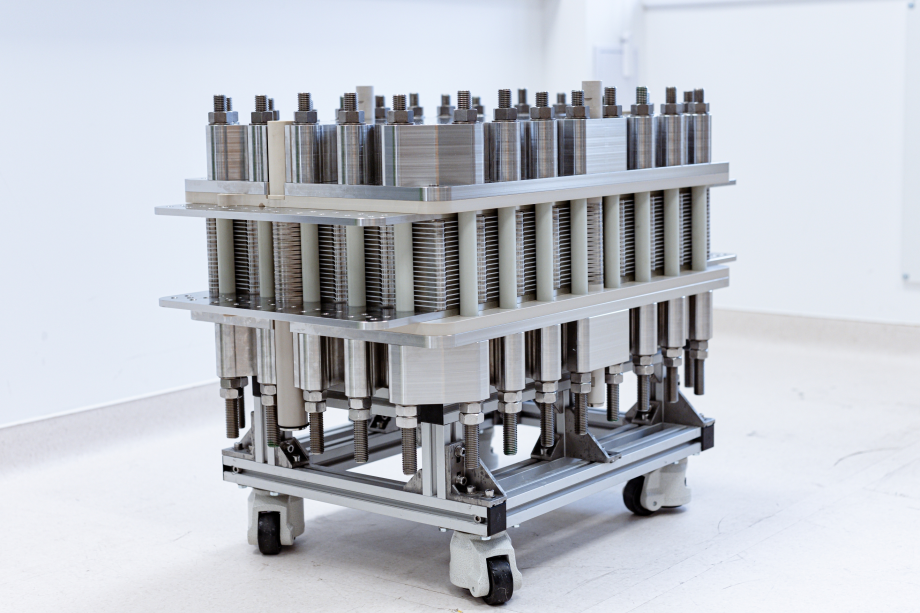 |
| Invention of eChemicles Zrt. - Photo: Hungarian Innovation Association |
Beyond enabling the green production of this raw material, what makes your technology so advantageous?
On of the problems with carbon monoxide is that it is highly toxic; consequently, no one likes to store it – and neither do we. That is exactly why the core of our business model is to produce carbon monoxide where and when it is needed, allowing it to be consumed immediately on-site during subsequent technological steps. There are many users, such as those in the semiconductor industry, agrochemistry, fragrance manufacturing, and the pharmaceutical industry, only require carbon monoxide in smaller quantities. Until now, they have sourced this hazardous gas from a manufacturer in pressurised cylinders, which then required transport and storage. For them, a viable solution is to place one of our containers at their site; when they reach a stage in their operations that requires carbon monoxide, they simply press a button and produce the required amount. There is no need for transportation or storage.
We have several prototypes of these container-sized units, which, as I mentioned, are being tested in various industrial environments. Our goal is to develop a product that meets all certification requirements, is sufficiently robust, and easy to operate. Initially, we are targeting users who currently purchase carbon monoxide in high-pressure tanks, and we expect to sell the first such containers to customers as early as next year. At the same time, these units can pave the way toward large-scale users: before someone commits to building a full-scale plant unit, they can purchase a container from us to test it at their own site and see how it performs.
In parallel, we are continuously working on scaling up. The good news – and this is an advantage of all electrochemical technologies – is that scaling up in this case is much simpler than is typical in the chemical industry: if we want to increase output volume, we simply need to place more electrolyser cells side-by-side. In other words, achieving tenfold or even hundredfold capacity does not require a new technological breakthrough – “only” an increase in scale. If one container holds one electrolyser stack, then a factory will have ten, fifty, or a hundred, depending on the required capacity.
What does the NRDI Office DeepTech Award mean to you?
We have received quite a number of awards on the international stage over the past two years, but this is our first major recognition in Hungary. It is always rewarding when one’s activities are recognised within their own environment and home country. At our core, we are a company with a global mindset, focusing on international markets, but we operate here in Hungary and work with Hungarian engineers and developers. It is important for us that our activities are known and recognised domestically as well – an effort that has also been supported by nearly HUF 270 million in funding from the NRDI Office’s Fast Track programme. In addition, certain costs related to patenting the invention were also covered through grant funding.
What are your longer-term plans, and what does the future hold for your technology?
One of our containerised units has just been shipped to Austria, where it will be tested for three months at one of Europe’s largest steel plants. This is a major milestone, but I believe an even more significant step will be the establishment of our first small-scale plant – expected in the first half of 2028 – which will be industrial-sized rather than container-sized.
What we still have a lot of work to do on is the conversion of carbon monoxide into ethylene, for which there is massive interest worldwide. This can be achieved in a different type of electrochemical reactor, where we feed in carbon monoxide and ethylene is produced as the output. Polyethylene, the most commonly used plastic, is made from ethylene; thus, ethylene is the highest-volume chemical produced globally, representing vast market opportunities. We are still in the development phase, but I am confident that we will soon have highly visible results in this area as well.
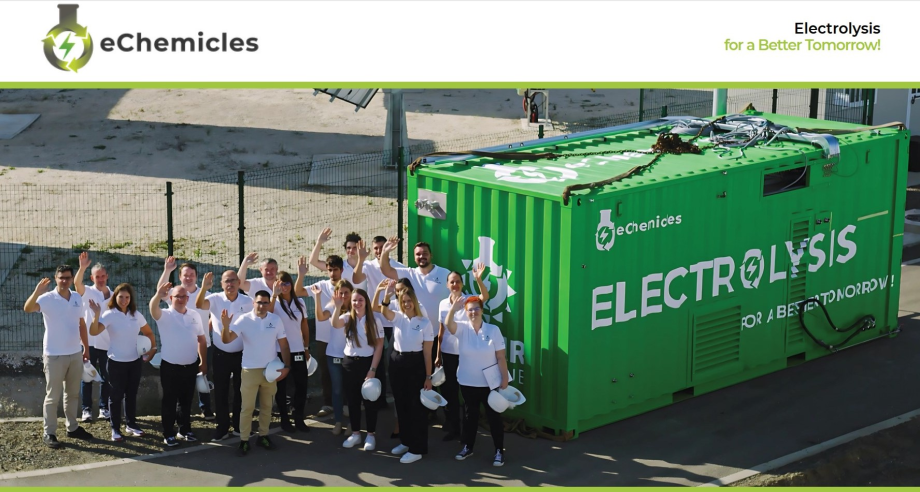 |
| eChemicles Zrt. team - Photo: eChemicles Zrt. |